
Query fan out is what happens when an engine takes one user question and silently turns it into many related sub-queries, then pulls the best passages (not just pages) across the web to synthesize one answer.
For search engine optimisation (SEO) and specifically generative engine optimisation (GEO), you shouldn’t be just picking one keyword/query and trying to rank for it. Instead, you should be trying to cover the full set of sub-intents and keyword variants, and ensure your content is easy to extract, cite and combine.
At its core, query fan-out breaks one search into multiple sub-queries to cover different intents and then synthesizes results. Query expansion modifies a query by adding related terms or synonyms to retrieve broader matches. Fan-out is intent-branching; expansion is term-broadening.
Query Fan-Out Summary:
– Query fan-out expands a single query into multiple intent-based searches.
– AI results often cite chunks (2-4 sentence passages) that answer a specific sub-question clearly
– The content that wins is facet-complete: definitions, comparisons, constraints, examples, and “next-step” organised advice into clean sections.
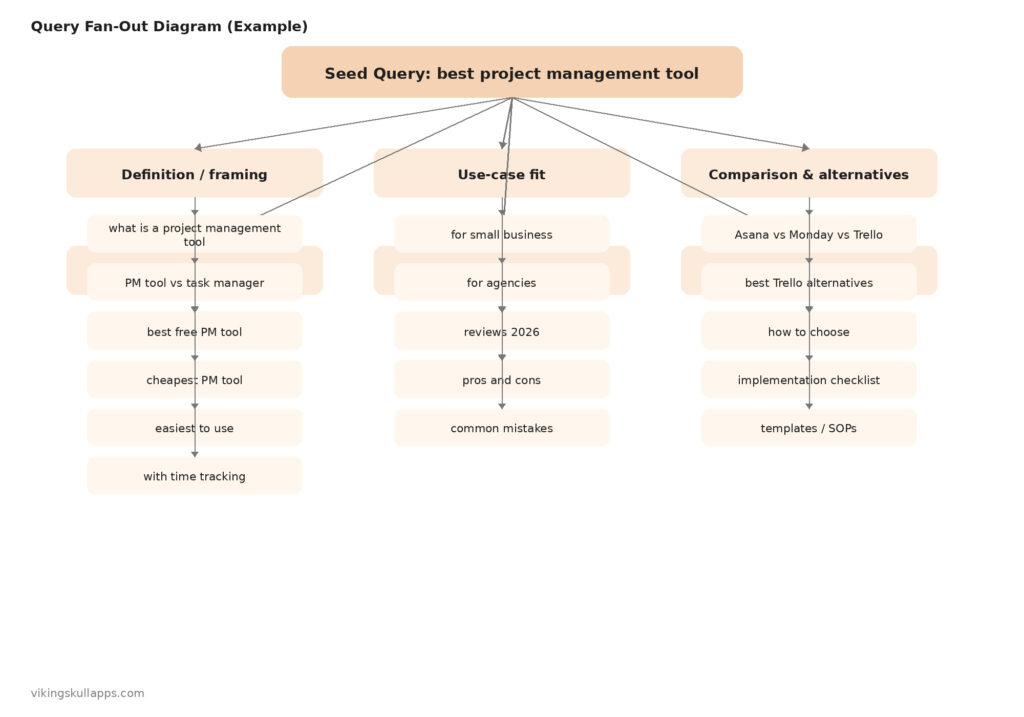
What Query Fan-Out Changes
Traditional SEO rewarded a single page for a single obvious query. Whereas, query fan-out shifts visibility from page level ranking to passage-level contribution. Instead of treating a query as one request, AI search expands it into multiple sub-questions, retrieves answers in parallel and surfaces the strongest self-contained passages for each facet.
Instead of focusing on if the page ranks, focus should be on whether the page contains the clearest, most complete passage for a key sub-intents.

This is why structure matters. AI systems look for tight, quotable chunks: a definition, a direct explanation, a concrete example and then combine those passages with other sources to produce the final response.
To summarise, query fan-out is an AI-search retrieval technique where a system:
- interprets the user’s question
- generates multiple sub-queries that represent different angles of intent
- retrieves results in parallel
- extracts the most relevant passages
- merges them into a single AI-style response with supporting links
Query Fan-Out in Google AI Mode
Google popularized the term “query fan-out” as part of its rollout of AI Mode in Search. In Google’s own explanation, AI Mode runs multiple searches behind the scenes by breaking a question into subtopics and issuing many related queries in parallel.
“Both AI Overviews and AI Mode may use a “query fan-out” technique — issuing multiple related searches across subtopics and data sources — to develop a response.”
Source: https://developers.google.com/search/docs/appearance/ai-features
In other words, AI Mode is designed for questions that would normally take several searches. Rather than returning one list of links, it gathers evidence across subtopics and sources, then synthesizes an answer with citations for deeper exploration.
Google also notes that AI Overviews and AI Mode may use query fan-out, issuing multiple related searches across subtopics and data sources to develop a response.
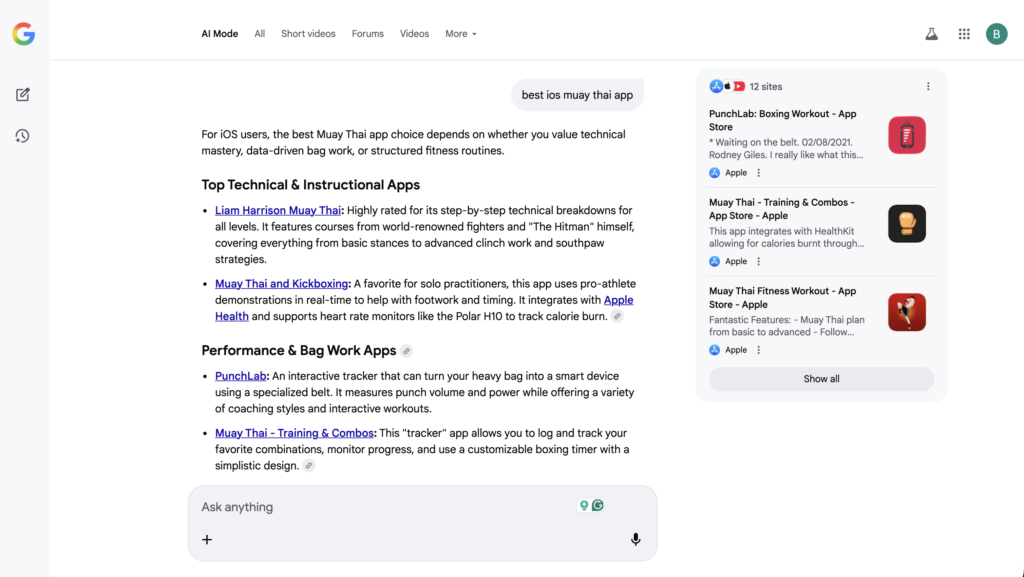
How Query Fan-Out Works Under the Hood
Query fan-out transforms a single search entry into an automated, multi-step research process. Rather than looking for a single “best match” page, the system issues multiple related searches across various subtopics and data sources to construct a comprehensive answer.
The 5-Step Pipeline:
- Interpret Intent. The system analyzes the core query to identify user intent and define what a “complete” answer requires, be it definitions, technical examples or comparative analysis.
- Generate Sub-Queries (The Fan-Out). The original query is decomposed into a series of targeted searches. This expansion covers different angles, edge cases, and logical follow-up questions that a human researcher might ask.
- Parallel Retrieval. These sub-queries are executed concurrently. This parallel processing allows the system to gather a broader and more diverse set of evidence much faster than sequential searching.
- Granular Extraction. Instead of just ranking web pages, the system extracts “self-contained chunks”, specific passages, data points or steps, that directly address each generated sub-query.
Synthesis & Attribution. The final response is synthesised from these extracted fragments. The system weaves the information into a cohesive narrative while providing citations and links back to the original sources.
How Users Prompt AI on Query Fan-Out
In the era of AI search, winning the “primary keyword” is only half the battle. The core implication is that one single search becomes a bundle of intents. To get cited, your content must provide the best “passage-level” answer for each specific branch of the fan-out.
- Breakdown of the “Bundle”
| Intent Cluster | Sample Sub-Queries (The Fan-Out) | What to Build for the “Win” |
| Definition + Context | “What is {{KEYWORD}}” “{{KEYWORD}} definition” | The “Glossary” Block: A clear TL;DR box or a 50-word definition in the first 15% of the page |
| Mechanics | “How {{KEYWORD}} works step by step” “{{KEYWORD}} in {{TOPIC}}” | The “Logic” Chunk: Use ordered lists, Mermaid diagrams or comparison tables that AI can easily parse and display |
| Impact & Strategy | “How to {{KEYWORD}}” “{{KEYWORD}} vs. {{TOPIC}}” | The “Authority” Cluster: Deeply linked sections that compare concepts and prove topical expertise through nuance |
| Tools + Tracking | “How to {{KEYWORD}}” “Tools for {{TOPIC}}” | The “Utility” Module: Actionable checklists, software reviews, or code snippets wrapped in Structured Schema (HowTo/Product) |
- The Core Implication for 2026
Traditional SEO focused on ranking in position #1. In the era of Generative Engine Optimization (GEO), success is measured by Citation Frequency.
- One Page, Many Passages: Your page is no longer a single, locked unit;. It is now a library of retrievable modules.
- The Extraction Win: You don’t need to be the #1 ranked site for a broad term to be the featured answer. If your specific section is the most structured and authoritative, the AI will pull your data as the primary citation, even if a legacy competitor has higher domain authority.
- Key Takeaway: Stop writing for the “head term.” Start writing “standalone chunks” that answer the sub-questions your audience (and the AI) will naturally ask next.
- Practical Tip: Finding the Fan-Out (using any LLM)
Most large language models will reveal their research logic if they are asked to plan before answering. You can force the model to display its sub-questions and search paths first, then use that output as a content checklist.
Step 1: Request a Research Plan
Before asking for a final answer, use a prompt that requires the model to show its work. This exposes the specific branches the AI considers essential for a complete response.
Prompt: Create a research plan to answer: [TOPIC]. List the sub-questions you would need to resolve before writing the final answer.
Prompt: Break [TOPIC] into subtopics and follow-up questions. Output as a numbered outline.
Step 2: Identify the Fan-Out Branches
The items in this plan are the specific components the model believes are required to achieve topical authority. These typically include definitions, technical comparisons, edge cases, and measurement risks.
Step 3: Stress-Test the Model’s Logic
To find the hidden branches that competitors might miss, push the model to refine its own plan.
- Ask: What subtopics are most often forgotten when discussing this?
- Ask: Remove any branches that do not matter for a beginner audience.
- Ask: What specific data points would make this research more credible?
Step 4: Execute a Content Gap Analysis
Compare the AI-generated research plan to your existing or planned page.
If the plan includes how to measure success and your article does not, you have a missing branch.
If the plan includes common misconceptions and your article lacks a dedicated section for them, you have another gap.
The Strategy: AI search engines do not just find answers; they predict what a complete answer requires. By turning that prediction into a checklist, you can build content that matches real follow-up intent. This ensures you are producing the exact standalone sections the engine is looking to cite.
Query Fan Out Tool: How to Identify Fan-Out Branches in Practice
There is no single public “query fan out tool” that reveals the exact sub-queries an AI search engine runs internally, most tools utilise various LLM APIs to generate fan outs.
The practical goal is to approximate the branches an engine is likely to explore an then publish the best standalone answer for each branch.
What a “query fan out tool” really does
A useful tool (or workflow) helps answer two questions:
- What follow-up questions does the topic naturally create?
- Which of those questions are worth building sections (or pages) for?
A simple 5-step workflow to map fan-out
Step 1: Start with the seed query
Write the exact phrase: “query fan out”.
Step 2: Generate the branch prompts (LLM plan-first method)
Ask any LLM:
- “Create a research plan for: query fan out. List the sub-questions required for a complete answer.”
The headings it produces are a working fan-out map.
Step 3: Validate branches with real search demand
Use autocomplete, “People also ask,” related searches and competitor headings to confirm the branches real users care about.
Step 4: Turn branches into page sections (or supporting pages)
Each branch becomes either:
- a standalone H2 section (best for closely related sub-intents), or
- a supporting article linked from the hub (best for deeper topics like tracking, tools, or case studies).
Step 5: Write “passage wins” under each heading
Under every branch heading, publish:
- a 2–4 sentence direct answer
- a list/table/steps (where relevant)
- one example (minimum)
The 2026 Tool Stack
| Function | 2026 Tool Categories | Specific Examples |
| Discovering Branches | Plan-First Prompts | Gemini 3 (Deep Research), Perplexity (Pro Search), Claude 3.5 or ChatGPT |
| Prioritizing Intent | Intent Clustering Tools | AlsoAsked or Keyword Insights (to group variants into single branches) |
| Tracking Citations | GEO Visibility Trackers | Ahrefs Brand Radar (to see which branches you are winning) |
The Bottom Line: The most effective query fan-out tool is a repeatable workflow. You generate the branches, validate the demand, publish modules designed for extraction, and track which specific sections get cited.
Fan-Out Map: What an AI Does With a Query Like “Generative Engine Optimisation”
A query like “generative engine optimisation” usually signals that the user wants more than a definition. AI search tends to fan this out into parallel branches: meaning, differences, how to do it, how to measure it and what to avoid.
Seed query
Generative engine optimisation
Likely fan-out branches (real prompts users type)
1) Definition + basics
- “What is generative engine optimisation?”
- “Generative engine optimisation meaning”
- “Is GEO the same as AI SEO?”
2) GEO vs SEO (comparisons)
- “GEO vs SEO: what’s the difference?”
- “Does GEO replace SEO?”
- “SEO for AI Overviews vs traditional rankings”
3) How GEO works (mechanics)
- “How do AI search engines choose sources?”
- “Why do AI results cite passages instead of pages?”
- “What is a query fan-out and how does it affect GEO?”
4) How to optimise for GEO (playbook)
- “How to get cited in AI answers”
- “How to structure content for AI search”
- “Best format for citation-ready paragraphs”
- “What schema helps with AI visibility?”
5) Measurement + reporting
- “How do I track AI citations and mentions?”
- “How to measure GEO success”
- “What KPIs matter for AI search visibility?”
6) Tools
- “Best GEO tools”
- “AI visibility tracking tools”
- “How to do GEO without paid tools”
7) Use cases (examples)
- “GEO strategy for e-commerce”
- “GEO for SaaS / B2B”
- “GEO for local businesses”
8) Risks + limitations
- “Does GEO reduce website traffic?”
- “How to handle outdated AI answers”
- “How to protect brand accuracy in AI search”
How to use this fan-out map in content
This is the clean hub structure:
- A GEO hub page covers each branch (fan-out) with short, standalone sections
- Each branch links to one deeper supporting article:
- GEO vs SEO
- Query fan-out explained
- How to get cited
- How to track citations (tools + workflow)
- GEO vs SEO
How to Win the “Passage Citation”
To win passage-level citations in AI search, a page needs more than broad coverage; it needs extractable passages that answer specific prompts cleanly and can stand alone.
That starts with placing a clear 50-word definition in the first part of the page, then turning common fan-out questions into H2/H3 headings and answering each one immediately with a tight 2–4 sentence response before expanding.
Keep paragraphs focused on a single idea, use numbered steps for workflows, and add short “vs” comparisons for common contrasts like fan-out vs query expansion.
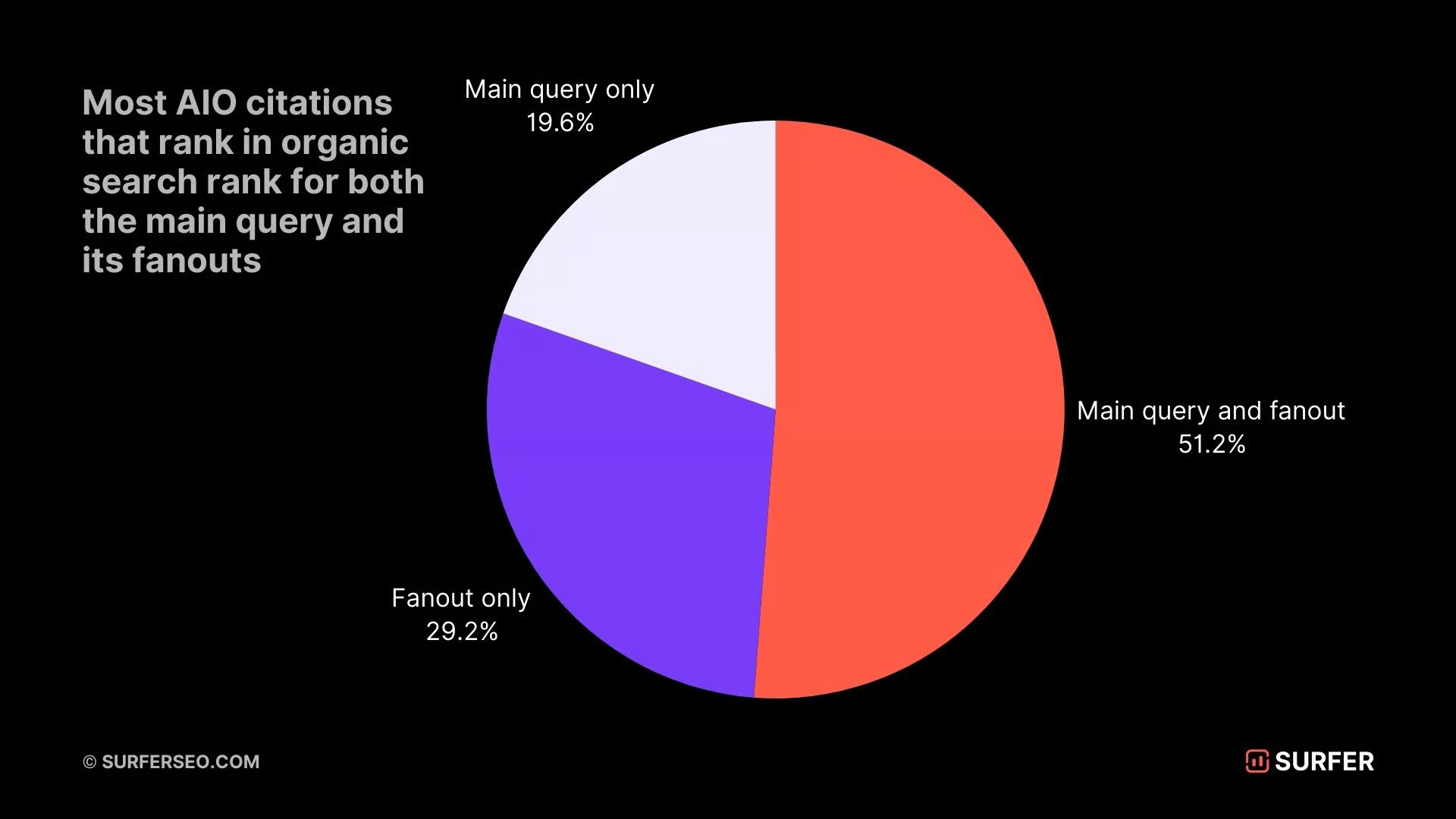
Include at least one concrete example (such as a fan-out map) and format key terms so they’re easy to scan.
Finally, support important claims with credible sources and dates where freshness matters, and add structured data only when it genuinely fits, FAQPage for real FAQs, HowTo for true step-by-step processes and Product/Review schema for legitimate tool reviews.
FAQ: Understanding the Query Fan-Out Process
What is query fan-out?
Query fan-out is a retrieval technique where an AI search engine takes a single user prompt and expands it into multiple, simultaneous sub-queries. The goal is to cover every possible angle of the user’s intent, definitions, steps, comparisons, and examples – before synthesising a final, unified answer.
Why is query fan-out important for search visibility?
In the era of Generative Engine Optimisation (GEO), AI search results prioritise specific passages over whole pages. Because the engine is running multiple hidden searches in the background, your content only appears if you have a “standalone module” that perfectly matches one of those background branches.
How is query fan-out different from keyword expansion?
Traditional keyword expansion adds synonyms to help a page rank for different word variations. Query fan-out is intent-branching; it doesn’t just look for different words, it looks for different questions.
Can I see the fan-out branches for my topic?
Yes. You can approximate the fan-out by asking an LLM to create a “research plan” for your topic before answering. In 2026, tools like Gemini also show this in real-time through the Research Plan or Thinking interface during Deep Research.
Does query fan-out reduce website traffic?
It changes the nature of the traffic. While users may get their quick “What is” answer directly from the AI, they still click through to sources that provide the deep “How-to” data, original research, or specific tools mentioned in the fan-out branches. Winning a citation makes your brand the trusted next step.
What is the most important “on-page” signal for GEO?
In 2026, Formatting and Structured Data (Schema) are the primary signals. AI models use Retrieval-Augmented Generation (RAG) to build their answers and prefer content that minimizes noise and maximises fact density.
- Answer-First Formatting: Placing a direct, 40–60 word answer immediately after an H2/H3 heading increases citation odds by over 60%.
- Modular Chunks: Use bullet points, numbered lists, and tables. These are “extractable units” that AI can pull into its response with near-perfect accuracy.
- Schema Markup: JSON-LD (like FAQPage or HowTo) acts as a direct line to engines, helping them verify your facts and reducing the risk of “hallucinations” when the AI cites you.
Final Summary: The Fan-Out Strategy
Query fan-out is the shift from ranking a page for one keyword to earning citations for many sub-questions. AI search systems take a single query, branch it into multiple related searches, and then assemble an answer by pulling the clearest passages from across the web. In practice, that means one page can win visibility in several places—if it’s built as a set of standalone, extractable modules.
The strategy is straightforward: map the fan-out branches, publish standalone chunks that answer each branch cleanly, structure content for easy extraction (clear headings, lists, comparisons, schema where it fits), and track citation frequency to see which sections are actually winning.
Need help with your business? Ben is a freelance SEO/GEO contractor who helps companies build citation-ready content, topic clusters and tracking systems designed for AI search visibility.

https://vikingskullapps.com/contact